

Product Description
ORABOND 1327 solves two problems at once: a surface that's low-energy and rough. It carries 3.5 mil of modified solvent acrylate — half again as thick as its sibling ORABOND 1325 — with the same aggressive initial grab, so it wets down into texture on the plastics and foams where ordinary acrylic transfer tapes simply won't hold. UL 969 certified. 55-yard rolls in 12", 24" and 48", plus narrow slit widths.
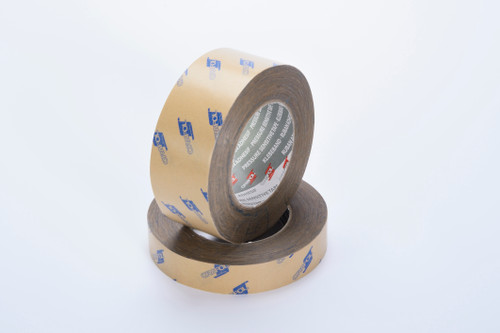
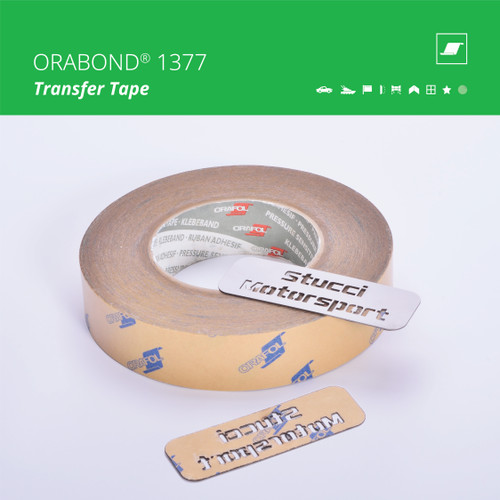
- 3.5-mil modified solvent acrylate (AM12), unsupported — no carrier
- For rough and slightly structured or stamped surfaces that are also low-energy
- Highest initial grab in the ORABOND transfer line — 5.71 lb/in at one minute, 6.40 lb/in at 24 hours
- Especially recommended for low-energy plastics and for bonding foams
- -40°F to +302°F, momentary to 374°F
- UL 969 certified
- 55-yard rolls in 12", 24", 48"; narrow slit widths available
Where 1327 fits
ORAFOL's transfer tape line splits along two axes, and 1327 sits at the corner where both get difficult. The pure acrylic tapes (1375, 1377) deliver maximum shear and heat resistance on cooperative surfaces. The modified acrylate tapes (1325, 1327) trade some of that away for the aggressive initial grab that low-energy plastics and foams demand. Within each pair, the thicker tape handles texture.
| Smooth surfaces | Rough / textured | |
|---|---|---|
| High-energy substrates metal, painted panel, ABS, PC |
ORABOND 1375 2.25 mil pure acrylic |
ORABOND 1377 4.75 mil pure acrylic |
| Low-energy substrates PP, PE, TPO, foams, powder coat |
ORABOND 1325 2.25 mil modified acrylate |
ORABOND 1327 3.5 mil modified acrylate |
If you've tried 1325 on a textured polypropylene housing or a coarse foam and watched the edges lift, 1327 is the answer — same adhesive family, enough thickness to reach into the low spots.
What it's for
- Textured low-energy plastic parts — molded PP and PE housings with tooling texture, grained TPO
- Foam bonding on rough or open surfaces — gaskets, seals, weatherstrip, cushioning
- Powder-coated and textured painted substrates where wet-out is the challenge
- Stamped and embossed parts in low-energy materials
- Assemblies needing immediate handling strength — the high initial grab means parts hold position without fixturing
- Die-cut gaskets, spacers and custom shapes — unsupported construction die-cuts cleanly
Why thickness and surface energy are separate problems
They get confused constantly, and choosing for one while ignoring the other is how a bond fails in service rather than on the bench.
Surface energy is chemistry — whether the adhesive can wet out and grip the material at all. Polypropylene, polyethylene, TPO, powder coats and most foams are low-energy: adhesive beads up instead of flowing out. No amount of extra thickness fixes a chemistry mismatch.
Thickness is geometry — whether the adhesive can reach into the surface texture and make real contact area. On a rough part, a thin adhesive bridges the peaks and leaves voids in the valleys, so you get a fraction of the contact you think you have. No amount of adhesive aggressiveness fixes a geometry mismatch.
1327 addresses both: modified acrylate chemistry for the low-energy problem, 3.5 mil for the texture problem.
The full ORABOND transfer tape line
| 1325 | 1327 | 1375 | 1377 | |
|---|---|---|---|---|
| Adhesive | Modified acrylate | Modified acrylate | Pure acrylic | Pure acrylic |
| Thickness | 2.25 mil | 3.5 mil | 2.25 mil | 4.75 mil |
| Peel at 1 min | 5.25 lb/in | 5.71 lb/in | 3.43 lb/in | 3.38 lb/in |
| Peel at 24 hr | 6.17 lb/in | 6.40 lb/in | 4.57 lb/in | 5.48 lb/in |
| Shear at 73°F | >500 hr | >500 hr | >1,000 hr | >1,000 hr |
| Shear at 158°F | >10 hr | >10 hr | >72 hr | >72 hr |
| Max temp | 302°F | 302°F | 338°F | 338°F |
| Surface | Smooth to slightly rough | Rough, structured, stamped | Smooth or lightly porous | Rough, structured, stamped |
Read it as a grid, not a ladder. Higher peel doesn't mean stronger overall — the modified acrylate tapes grip harder and hold shear worse. Pick the row that matches your substrate first, then the column that matches your load.
Application notes
- Roll it on at the shallowest angle you can. Standard practice for any transfer tape — it's what keeps air out of the bond line.
- Apply above 59°F.
- Clean and dry both surfaces. On molded plastic, mold release is the usual culprit and it defeats any adhesive. On textured parts, get contamination out of the low spots — not just off the high ones.
- Position carefully the first time. At 5.71 lb/in after one minute, there is effectively no repositioning window.
- Firm, even roller pressure. On a rough low-energy surface, pressure is what forces the adhesive down into the texture and makes contact area.
- Test on your actual parts. "Low surface energy" spans a wide range, and a PP blend from one molder behaves differently from another's. Run a peel test on production parts before a full run.
Technical data
| Construction | Unsupported transfer tape — no carrier |
| Adhesive | AM12 modified solvent acrylate |
| Thickness (adhesive without liner) | 3.5 mil |
| Liner | Both sides siliconized PE paper, brown, 68# |
| Adhesive power (FINAT TM 1, stainless steel) | 5.71 lb/in at 1 min; 5.94 lb/in at 20 min; 6.40 lb/in at 24 hr |
| Shear strength (FINAT TM 8, stainless steel) | >500 hr at 73°F; >10 hr at 158°F |
| Temperature resistance | -40°F to +302°F, momentary up to 374°F |
| Solvent and chemical resistance | With expert application, resistant to most mineral oils, fuels, greases, aliphatic solvents, weak acids, salts and alkalis |
| Certification | UL 969 |
| Application temperature | Above 59°F |
| Shelf life | 2 years in original packaging at 68°F / 50% RH |
| Roll length | 55 yards |
| Widths | 12", 24", 48" — narrow slit rolls also available |
Adhesive and shear values are averages measured with one side covered with 2-mil polyester film. Source: ORAFOL Americas ORABOND 1327 Technical Datasheet, rev. 07/19.
Need a narrow width? ORAFOL slits 1327 down to 1/2", 3/4", 1", 1-1/2", 2", 3" and 4" — useful if you're running gasket or weatherstrip work and don't want to convert full rolls. Call (602) 272-8655 or email Sales@kgsupplies.com for availability and lead time.
We also run an in-house roll slitting service for custom sizes — allow 48–72 hours. Same-day local delivery in Phoenix Metro, overnight across Arizona, New Mexico, Nevada and Colorado, UPS nationwide.
Frequently asked questions
1325 or 1327?
Surface texture decides it. Both use the same modified acrylate chemistry for low-energy plastics and foams; 1325 at 2.25 mil is for smooth to slightly rough surfaces, 1327 at 3.5 mil is for rough, structured and stamped ones. Shear, temperature range and application temperature are identical — you're buying thickness.
Which ORABOND transfer tape do I need overall?
Two questions. Is the substrate low-energy — polypropylene, polyethylene, TPO, foam, powder coat? If yes you're in the 1325/1327 pair; if no, the 1375/1377 pair. Then: is the surface rough or textured? If yes, take the thicker one of the pair. And sanity-check the load — the 1325/1327 pair is the weaker choice for sustained shear at high temperature.
Will it stick to polypropylene and polyethylene?
That's what the adhesive is formulated for, and the extra thickness helps on molded texture. But LSE plastics vary enormously by resin, filler and molding process, and no adhesive maker will guarantee a specific substrate sight unseen. Test on your production parts.
How hot can it get?
-40°F to 302°F with momentary excursions to 374°F. That's lower than 1375 and 1377 at 338°F. For sustained load at high temperature, use one of those.
Can I reposition after setting?
No. 5.71 lb/in in the first minute is the highest initial grab in the line — that's the feature, and the catch. Jig your parts or use registration marks.
Is this the same as sign application tape?
No. Application tape (ORATAPE HT55, MT95 and the rest) is a low-tack carrier for moving cut vinyl onto a substrate, then discarded. ORABOND 1327 is a permanent structural adhesive that stays in the assembly. If you're transferring cut lettering, you want application tape.
WARNING: This product may expose you to chemicals which are known in the State of California to cause cancer and birth defects or other reproductive harm. For more information go to P65Warnings.ca.gov.
Published information is based on ORAFOL research believed to be reliable, but does not constitute a warranty. Because of the variety of uses and the continuing development of new applications, the purchaser should evaluate suitability and performance for each intended use and assumes all risk regarding such use. Specifications are subject to change without notice. ORABOND® and ORATAPE® are registered trademarks of ORAFOL Europe GmbH.