
Product Description
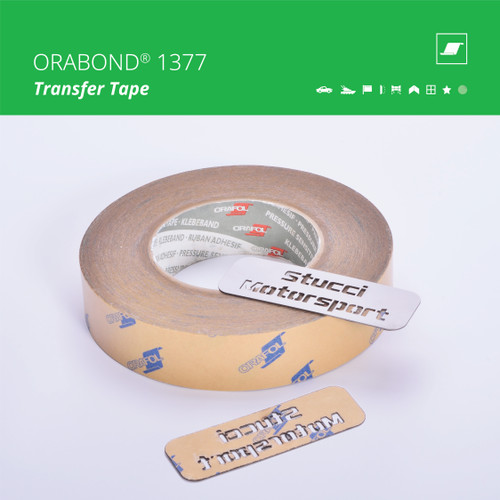
ORABOND 1377 is an unsupported adhesive transfer tape carrying 4.75 mil of pure acrylic adhesive on a double-sided siliconized liner, with no carrier film between the bonded surfaces. The extra adhesive thickness is the whole point: it wets out into rough, structured and stamped surfaces that a thin transfer tape can't grip. Built for permanent bonding of nameplates, fascia panels and display components where the joint has to carry shear load and survive heat, UV and solvent exposure. 55-yard rolls in 12", 24" and 48".
- 4.75-mil pure acrylic (A7) adhesive, unsupported — no carrier
- Specified for rough, structured and stamped surfaces
- 5.48 lb/in peel on stainless after 24 hours (3.38 lb/in at one minute)
- Over 1,000 hours static shear at 73°F; over 72 hours at 158°F
- -40°F to +338°F continuous, momentary to 392°F
- Excellent UV, solvent, chemical and humidity resistance
- 55-yard rolls in 12", 24" and 48"; 2-year shelf life
What it's for
ORAFOL positions 1377 as an adhesive medium for signs, decorations, front plates and displays needing extremely high shear strength, adhesion strength and temperature resistance — specifically where the surface isn't smooth. In practice:
- Powder-coated and textured metal — enclosures, panels, brackets
- Stamped and embossed parts where the surface carries tooling texture
- Metal and plastic nameplates on non-smooth housings — serial plates, rating plates, equipment ID
- Fascia panels and front plates for electronics and control enclosures
- Sign and display fabrication — bonding trim, dimensional letters and panel components to textured faces
- Die-cut gaskets, spacers and custom shapes — the unsupported construction die-cuts cleanly
Why the extra thickness works
A transfer tape bonds only where the adhesive actually touches the substrate. On a textured surface, a thin adhesive bridges the peaks and leaves voids in the valleys — you might be getting half the contact area you think you are, which shows up as edge lifting and eventual release under load. A 4.75-mil adhesive has enough body to flow into that texture and build real contact area.
You can see it in ORAFOL's own numbers: at one minute, 1377 actually reads slightly lower than 1375 (3.38 vs 3.43 lb/in) because the thicker adhesive takes longer to wet out. By twenty-four hours it's ahead — 5.48 vs 4.57 lb/in. The thicker tape rewards dwell time.
Unsupported construction
Transfer tape is adhesive with no carrier — just a film of adhesive on a release liner. Against a double-sided tape with a PET or tissue carrier, that gives you:
- No visible line. Nothing telegraphs through a faceplate or shows at a bonded edge.
- Direct load path. No carrier layer to shear between the two surfaces — that's where the 1,000-hour static shear figure comes from.
- Clean die-cutting. No carrier to fracture or fray on intricate cuts.
ORABOND 1375 vs. 1377
| ORABOND 1375 | ORABOND 1377 | |
|---|---|---|
| Adhesive thickness | 2.25 mil | 4.75 mil |
| Specified for | Smooth or lightly porous surfaces | Rough, structured and stamped surfaces |
| Peel at 1 min | 3.43 lb/in | 3.38 lb/in |
| Peel at 24 hr | 4.57 lb/in | 5.48 lb/in |
| Shear strength | >1,000 hr at 73°F | >1,000 hr at 73°F |
| Temperature resistance | -40°F to +338°F | -40°F to +338°F |
| Adhesive / liner | A7 pure acrylic, brown 68# PE | A7 pure acrylic, brown 68# PE |
Quick way to choose: run a fingernail across both surfaces. If you can feel texture on either one, you want 1377. If both are smooth sheet metal, painted panel or high-energy plastic, 1375 will do the job with less adhesive and less cost. Not sure? Call us and describe the parts — this is an easy one to get wrong and an expensive one to rework.
Application notes
- Roll it on at the shallowest angle you can. ORAFOL calls this out specifically for transfer tape — a shallow application angle is what keeps air out of the bond line.
- Apply above 64°F. That's ORAFOL's minimum application temperature; a cold shop will cost you initial tack, and on a textured surface you need all the wet-out you can get.
- Clean and dry both surfaces — free of dust, oil, mold release and residue. On textured or stamped parts, that means getting contamination out of the low spots, not just wiping the high ones.
- Give it dwell time. Bond builds from 3.38 lb/in at one minute to 5.02 at twenty minutes to 5.48 at twenty-four hours. Don't load or stress-test the joint immediately after assembly.
- Pressure matters more on rough surfaces. Firm, even roller pressure is what pushes the adhesive down into the texture.
- Chemical resistance follows the bond. With correct application, 1377 resists most mineral oils, fuels, greases, aliphatic solvents, weak acids, salts and alkalis.
Technical data
| Construction | Unsupported transfer tape — no carrier |
| Adhesive | A7 pure acrylic, high-performance modified solvent acrylate, permanent |
| Thickness (adhesive without liner) | 4.75 mil (120 micron) |
| Liner | Both sides siliconized PE paper, brown, 68# |
| Adhesive power (FINAT TM 1, stainless steel) | 3.38 lb/in at 1 min; 5.02 lb/in at 20 min; 5.48 lb/in at 24 hr |
| Shear strength (FINAT TM 8, stainless steel) | >1,000 hr at 73°F; >72 hr at 158°F |
| Temperature resistance | -40°F to +338°F, momentary up to 392°F |
| Solvent and chemical resistance | With expert application, resistant to most mineral oils, fuels, greases, aliphatic solvents, weak acids, salts and alkalis |
| Application temperature | Above 64°F |
| Shelf life | 2 years in original packaging at 68°F / 50% RH |
| Roll length | 55 yards |
| Widths | 12", 24", 48" |
Adhesive and shear values are averages measured with one side covered with 2-mil polyester film. Source: ORAFOL Americas ORABOND 1377 Technical Datasheet, rev. 06/26.
Splice Free Guarantee
ORAFOL guarantees every roll of ORABOND adhesive tape to be free from splices. Identify a verifiable splice and ORAFOL replaces the roll at no cost and sends you $500.
Need a width we don't stock? Email Sales@kgsupplies.com or call (602) 272-8655. We run an in-house roll slitting service and can cut 1377 down to your size — allow 48–72 hours.
Buying transfer tape by the case? Ask about our B2B program. Same-day local delivery in Phoenix Metro, overnight across Arizona, New Mexico, Nevada and Colorado, UPS nationwide.
Frequently asked questions
Should I order 1377 or 1375?
Surface texture decides it. 1377 at 4.75 mil is specified for rough, structured and stamped surfaces; 1375 at 2.25 mil is for smooth or lightly porous ones. Same adhesive chemistry, same temperature range — you're buying adhesive thickness, not a different tape.
What's the difference between transfer tape and double-sided tape?
Transfer tape is adhesive only — no carrier film. Double-sided tape has a carrier (PET, tissue, foam) with adhesive on both faces. Transfer tape gives a thinner, invisible bond line and direct load transfer; double-sided tape gives gap-filling and easier handling.
Is this the same as sign application tape?
No, and it's an easy mix-up. Application tape (ORATAPE HT55, MT95 and the rest) is a low-tack carrier you use to move cut vinyl onto a substrate and then discard. ORABOND 1377 is a permanent structural adhesive that stays in the assembly. If you're transferring cut lettering, you want application tape.
How rough is too rough?
ORAFOL specifies 1377 for rough, structured and stamped surfaces but publishes no roughness limit. On deeply textured, porous or irregular substrates — raw concrete, coarse castings, open-cell material — a transfer tape of any thickness runs out of road and you want a foam or UHB tape that can compress into the gap. Tell us what you're bonding and we'll help you draw the line.
Can I reposition a part after I set it?
Treat it as permanent. Peel builds from 3.38 lb/in at one minute to 5.48 at twenty-four hours, so there's little forgiveness even early on. Jig your parts or use registration marks rather than planning to lift and reset.
Will it bond to polyethylene or polypropylene?
Those are low-surface-energy plastics. ORAFOL rates 1377 as extremely durable on metal, varnish and high-energy plastics and only "very durable" on low-energy surfaces. For LSE plastics, look at a tape formulated for them and test on your actual parts before a production run.
Which width should I order?
12" and 24" are typical for die-cutting and general fabrication; 48" is for laminating full panels. If you're die-cutting shapes, order the width closest to your die so you're not wasting material.
WARNING: This product may expose you to chemicals which are known in the State of California to cause cancer and birth defects or other reproductive harm. For more information go to P65Warnings.ca.gov.
Published information is based on ORAFOL research believed to be reliable, but does not constitute a warranty. Because of the variety of uses and the continuing development of new applications, the purchaser should evaluate suitability and performance for each intended use and assumes all risk regarding such use. Specifications are subject to change without notice. ORABOND® and ORATAPE® are registered trademarks of ORAFOL Europe GmbH.