




Product Description
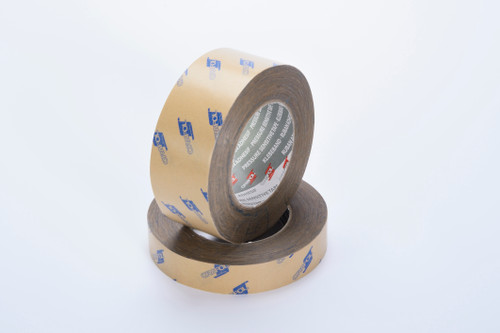
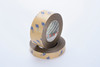
ORABOND 1325 is an unsupported transfer tape built for the surfaces that defeat ordinary acrylic adhesives. Its modified solvent acrylate grabs hard on contact — 5.25 lb/in in the first minute — and ORAFOL specifically recommends it for low-energy plastics and for bonding foams. If you've had a transfer tape lift off polypropylene, polyethylene or a foam gasket, this is the one to reach for. UL 969 certified. 55-yard rolls in 12", 24" and 48".
- 2.25-mil modified solvent acrylate, unsupported — no carrier
- Especially recommended for low-energy plastic surfaces
- High initial adhesion — 5.25 lb/in at one minute, building to 6.17 lb/in at 24 hours
- Ideal for bonding foams and materials needing very high adhesive strength
- -40°F to +302°F, momentary to 374°F; SAFT 302°F
- UL 969 certified
- 55-yard rolls in 12", 24" and 48"; 2-year shelf life
What "low surface energy" means, and why it matters
Surface energy determines whether an adhesive can wet out and grip. High-energy surfaces — metals, glass, painted panels, ABS, polycarbonate — let adhesive spread and bond readily. Low-energy surfaces resist it: polypropylene, polyethylene, PTFE, powder coats, many TPOs, and most foams. Adhesive beads up rather than flowing out, and a general-purpose tape that performs beautifully on aluminum will lift off the same part molded in PP.
ORABOND 1325 is formulated for that problem. ORAFOL calls it especially recommended for low-energy plastic surfaces and ideal as an adhesive medium for foams — two applications where the standard high-performance acrylics in the ORABOND line will disappoint you.
What it's for
- Bonding foams — gaskets, seals, cushioning, weatherstrip, EVA and PE foam assemblies
- Low-energy plastic parts — polypropylene and polyethylene housings, TPO, molded components
- Powder-coated surfaces where standard acrylics struggle to wet out
- Assemblies needing immediate handling strength — the high initial grab means parts hold position right away instead of needing fixturing
- Die-cut gaskets, spacers and custom shapes — unsupported construction die-cuts cleanly
- Mixed-substrate bonds where one side is a difficult plastic and the other is metal or painted panel
The tack-versus-shear tradeoff, in numbers
Look at how the three ORABOND transfer tapes behave over time and the design intent becomes obvious.
| ORABOND 1325 | ORABOND 1375 | ORABOND 1377 | |
|---|---|---|---|
| Adhesive thickness | 2.25 mil | 2.25 mil | 4.75 mil |
| Peel at 1 min | 5.25 lb/in | 3.43 lb/in | 3.38 lb/in |
| Peel at 24 hr | 6.17 lb/in | 4.57 lb/in | 5.48 lb/in |
| Shear at 73°F | >500 hr | >1,000 hr | >1,000 hr |
| Shear at 158°F | >10 hr | >72 hr | >72 hr |
| Temperature | -40°F to 302°F | -40°F to 338°F | -40°F to 338°F |
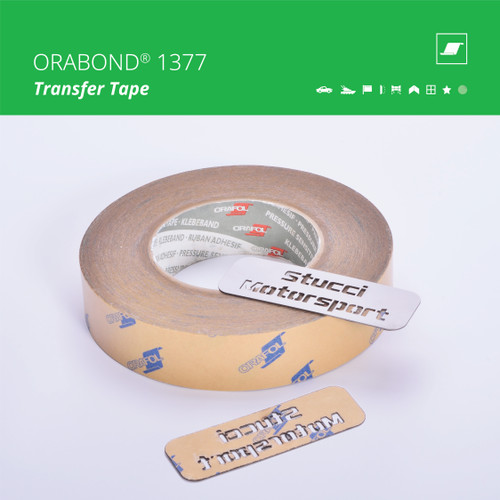
| Specified for | Low-energy plastics, foams, smooth to slightly rough | Smooth or lightly porous | Rough, structured, stamped |
1325 wins on peel at every time interval and loses on shear at every temperature. Peel is resistance to being pulled apart at an angle; shear is resistance to sliding under sustained load. Pick by which force your joint actually sees — a foam gasket on a plastic housing is a peel problem, a hanging nameplate on a hot enclosure is a shear problem.
Application notes
- Roll it on at the shallowest angle you can. Standard practice for any transfer tape — it's what keeps air out of the bond line.
- Apply above 59°F. That's ORAFOL's minimum for 1325, a few degrees lower than the 64°F minimum on 1375 and 1377.
- Clean and dry both surfaces — free of dust, oil, mold release and residue. Mold release is the usual culprit on molded plastic parts and it will defeat any adhesive.
- Position carefully the first time. High initial adhesion is the selling point and the catch — there's very little repositioning window at 5.25 lb/in after one minute.
- Firm roller pressure. On low-energy plastics, pressure is what forces wet-out.
- Test on your actual parts. "Low surface energy" covers a wide range, and a PP blend from one molder behaves differently from another's. Run a peel test on production parts before committing to a run.
Technical data
| Construction | Unsupported transfer tape — no carrier |
| Adhesive | Modified solvent acrylate |
| Thickness (adhesive without liner) | 2.25 mil (60 micron) |
| Liner | Both sides siliconized PE paper, brown, 68# |
| Adhesive power (FINAT TM 1, stainless steel) | 5.25 lb/in at 1 min; 5.71 lb/in at 20 min; 6.17 lb/in at 24 hr |
| Shear strength (FINAT TM 8, stainless steel) | >500 hr at 73°F; >10 hr at 158°F |
| Temperature resistance | -40°F to +302°F, momentary up to 374°F |
| Shear adhesion failure temperature (SAFT) | 302°F |
| Solvent and chemical resistance | With expert application, resistant to most mineral oils, fuels, greases, aliphatic solvents, weak acids, salts and alkalis |
| Certification | UL 969 |
| Application temperature | Above 59°F |
| Shelf life | 2 years in original packaging at 68°F / 50% RH |
| Roll length | 55 yards |
| Widths | 12", 24", 48" |
Adhesive and shear values are averages measured with one side covered with 2-mil polyester film. Source: ORAFOL Americas ORABOND 1325 Technical Datasheet, rev. 07/19.
Not sure this is the right tape for your substrate? Call (602) 272-8655 or email Sales@kgsupplies.com and tell us what you're bonding. Low-surface-energy work is where tape selection actually matters, and it's worth two minutes on the phone before you buy a case.
Need a custom width? We run an in-house roll slitting service — allow 48–72 hours. Same-day local delivery in Phoenix Metro, overnight across Arizona, New Mexico, Nevada and Colorado, UPS nationwide.
Frequently asked questions
Which ORABOND transfer tape do I need?
Start with the substrate. Low-energy plastic or foam, or you need instant grab: 1325. Smooth metal, painted panel or high-energy plastic: 1375. Rough, textured, powder-coated or stamped: 1377. Then sanity-check the load — if the joint carries sustained shear at elevated temperature, 1325 is the weakest of the three and you should look at 1375 or 1377.
Will it stick to polypropylene and polyethylene?
That's what it's formulated for — ORAFOL specifically recommends 1325 for low-energy plastic surfaces. But LSE plastics vary enormously by resin, filler and molding process, and no adhesive manufacturer will guarantee a specific substrate sight unseen. Test on your actual production parts.
Can I use it on foam?
Yes — ORAFOL lists foams as a primary application. The high initial adhesion is what makes it work, since foam offers a compressible, low-energy surface that thinner-tack adhesives struggle to hold.
How hot can it get?
-40°F to 302°F, with momentary excursions to 374°F, and a shear adhesion failure temperature of 302°F. That's lower than 1375 and 1377 at 338°F. For sustained load at high temperature, use one of those instead.
Can I reposition after setting?
Barely. 5.25 lb/in in the first minute is the highest initial grab in the ORABOND transfer line — that's the feature. Jig your parts or use registration marks; don't plan on lifting and resetting.
Is this the same as sign application tape?
No. Application tape (ORATAPE HT55, MT95 and the rest) is a low-tack carrier for moving cut vinyl onto a substrate, then discarded. ORABOND 1325 is a permanent structural adhesive that stays in the assembly. If you're transferring cut lettering, you want application tape.
WARNING: This product may expose you to chemicals which are known in the State of California to cause cancer and birth defects or other reproductive harm. For more information go to P65Warnings.ca.gov.
Published information is based on ORAFOL research believed to be reliable, but does not constitute a warranty. Because of the variety of uses and the continuing development of new applications, the purchaser should evaluate suitability and performance for each intended use and assumes all risk regarding such use. Specifications are subject to change without notice. ORABOND® and ORATAPE® are registered trademarks of ORAFOL Europe GmbH.