
What Is a Dual-Color Sign Film, and Why Does It Exist?
Dual-color film is a specialty product built around one optical trick: it lets a single built-up backlit channel letter or sign cabinet display two completely different visual states — one during the day or when the sign is off, and a different one at night when the sign is internally illuminated.
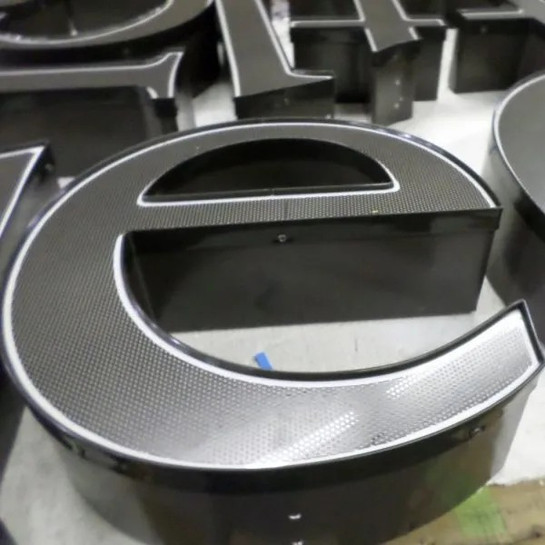
The construction is straightforward. The film is a perforated black (or sometimes white) vinyl applied to the outside face of a translucent acrylic letter or panel. During the day, ambient light reflects off the black film and the sign reads as a clean, solid black face — the perforations are too small to perceive from typical viewing distances. At night, internal lamps illuminate the translucent acrylic from behind, and the acrylic's color passes through the perforations — transforming that same sign into a glowing colored channel letter.
The application matters: it lets a fabricator build one set of letters with colored translucent acrylic, then create a dual-personality sign without running two separate vinyl applications or building two different letter sets. It's especially popular for upscale retail, restaurant, hospitality, and corporate identity signage where the daytime stealth-black look is part of the brand language.
Three products dominate this category in North America. Let's look at each, then put them side by side.
The Three Contenders
3M™ Dual-Color Film 3635-222 (Black)
3M's 3635-222 is the longest-running product in this space and the film most sign shops grew up specifying. It's a 5.5-mil matte cast PVC with a 15% perforation pattern, a permanent pressure-sensitive light-management adhesive, and white kraft paper liner. 3M positions it as a system designed to work alongside their Scotchcal™ Translucent Graphic Film Series 3630 on the second surface of the sign — the 3630 determines the nighttime color, the 3635-222 handles the daytime black face.
Expected performance life is up to 7 years on flat, vertical outdoor applications in non-abusive environments. The product bulletin lists solvent inkjet printing and screen printing as the approved print methods. The minimum application temperature is 60°F.
Contra Vision® Cast Black Dual Color — BBCRW20A
Contra Vision's premium cast offering is the direct head-to-head competitor to 3M 3635-222. It's a 4.72-mil cast PVC film with a 20% perforation pattern — one-third more open area than 3M's 15% — and the same up-to-7-year warranted durability in Zone 1 (United States, Canada). It uses a clear solvent acrylic pressure-sensitive adhesive and a Replacement Liner (white paper, PE and silicone coated).
Approved print methods are eco-solvent, solvent, latex/resin inkjet, and screen printing. UV-cure inkjet is not recommended on the Replacement Liner version. Minimum application temperature is 50°F.
Contra Vision® Performance™ Black Dual Color — BBPAG20A
BBPAG20A is the polymeric calendered, UV-printable sibling to BBCRW20A. It's a 5.91-mil semi-matt polymeric PVC with the same 20% perforation pattern, but with Contra Vision's Universal Liner featuring Grayliner™ technology. The Universal Liner is part-perforated and engineered specifically to eliminate the ink-bridging issue that affects UV-cure printing on standard perforated films — making this the only film in the comparison with documented compatibility across all five major print technologies: solvent, eco-solvent, latex/resin, UV-cure inkjet, and screen printing.
The trade-off is durability: BBPAG20A is rated for 3 years in Zone 1 versus 7 years for the cast versions. Minimum application temperature is 50°F.
Head-to-Head Specifications
| 3M 3635-222 | Contra Vision BBCRW20A | Contra Vision BBPAG20A | |
|---|---|---|---|
| Face Film | Matte cast PVC | Cast PVC | Semi-matt polymeric calendered PVC |
| Film Thickness | 5.5 mils (140 µm) | 4.72 mils | 5.91 mils (± 0.39 mils) |
| Perforation / Open Area | 15% | 20% | 20% |
| Liner | White kraft paper | Replacement Liner (PE + silicone coated paper) | Universal Liner with Grayliner™ |
| Adhesive | Permanent pressure-sensitive light-management adhesive | Clear solvent acrylic, semi-permanent | Transparent solvent polyacrylate, semi-permanent |
| Solvent Inkjet | ✓ | ✓ | ✓ |
| Eco-Solvent Inkjet | Not on approved list | ✓ | ✓ |
| Latex / Resin Inkjet | Not on approved list | ✓ | ✓ |
| UV-Cure Inkjet | Not on approved list | Not recommended | ✓ Recommended |
| Screen Printing | ✓ | ✓ | ✓ |
| Expected Life (North America) | Up to 7 years | Up to 7 years | 3 years |
| Min Application Temp | 60°F | 50°F | 50°F |
| Service Temp Range | -65°F to 225°F | -13°F to 149°F | -13°F to 149°F |
| Shelf Life | 2 years (manufacturer guidance) | 3 years | 2 years |
| Designed Translucent Pairing | 3M Scotchcal™ 3630 series | Translucent acrylic substrate | Translucent acrylic substrate |
Sources: 3M Product Bulletin 3635-200 (March 2017), Contra Vision Technical Data Sheets BBCRW20A v1.1 (October 2025) and BBPAG20A v1 (September 2025). Print compatibility ratings reflect manufacturer-approved print methods as listed in current product bulletins; films may print acceptably on additional platforms unsupported by the manufacturer — test before production runs.
Where 3M 3635-222 Wins
- Ecosystem integration with 3M Scotchcal™ 3630. 3M designed 3635-222 to be specified alongside their 3630 series translucent film on the second surface. If you're already building signs in the 3M color system — matching brand colors to 3M's translucent color library — staying in the 3M ecosystem keeps the warranty and color matching simple.
- Wider service temperature range. 3M specifies a service range of -65°F to 225°F, versus -13°F to 149°F for the Contra Vision options. For most channel letter applications this is academic, but it matters for extreme-environment installations.
- Industry familiarity. Most sign shops have a standing 3M account, a 3M rep, and decades of installed-base experience with this specific product. There's real value in working with what your installers already know.
Where Contra Vision Wins
1. Brighter Nighttime Illumination — 20% Open Area vs. 15%
Both Contra Vision dual-color films use a 20% perforation pattern. 3M 3635-222 uses 15%. That's a third more open area on the Contra Vision films, which translates directly into more transmitted light at night. For channel letters running modern LED modules — especially in larger letter geometries where edge falloff is a concern — the brighter glow can make the difference between a sign that pops at night and one that looks slightly muted.
Whether this matters for your project depends on what you're building. For high-end retail and hospitality brands that want maximum visual impact when the sign hits at dusk, the Contra Vision open area is a meaningful upgrade. For utility signage where the daytime look is the priority and the night look just needs to be readable, 3M's 15% is plenty.
2. Lower Minimum Application Temperature — 50°F vs. 60°F
Contra Vision specs both BBCRW20A and BBPAG20A down to 50°F. 3M specifies 60°F for 3635-222. In the Southwest this rarely matters — we're applying signs in 80°F-plus weather most of the year — but for installations in shaded north-facing exposures, early-morning starts in fall and spring, or any cool installation window, the 10-degree advantage gives installers more flexible scheduling without risking adhesive issues.
3. UV-Cure Print Compatibility (BBPAG20A Only)
This is the biggest single technical differentiator in the comparison, and it matters specifically to shops running flatbed or hybrid UV printers (Roland VersaUV, Mimaki UJF/JFX, HP Latex R-series, Epson SureColor V, Mutoh XpertJet UV, and so on).
Printing perforated films on UV-cure printers has historically been problematic. UV inks cure on contact with the lamp and can bridge across the perforation holes — the cured ink forms a film over the holes that doesn't separate properly when the liner is removed. The result is visible flash, ghosting, or perforation-pattern artifacts in dark areas of the design, particularly bad in solid blacks where the perforations should be invisible.
Contra Vision's Universal Liner with Grayliner™ technology is the engineered fix. It's a part-perforated silicone-coated paper laminated with grey-printed paper backprinted with the Performance™ branding. When properly printed on a UV machine, the ink can't bridge across the perforations because the liner geometry doesn't allow it. The cured print releases cleanly when the liner is removed.
3M's 3635-200 series Product Bulletin (Release I, March 2017) does not list UV-cure inkjet on the approved ink series for 3635-222. The approved methods are solvent inkjet (3M's own Series 8800, 8810, and several Roland and Mimaki solvent ink lines) and screen printing (3M Series 1900 solvent ink and Series 9800 UV screen ink). If you're running a flatbed or hybrid UV printer in your shop, BBPAG20A is the only film in this comparison the manufacturer explicitly recommends for that print process.
4. Two-Tier Product Family
3M offers one cast SKU (3635-222 black; 3635-210 white). Contra Vision offers a tiered family: BBCRW20A for long-term cast premium applications, BBPAG20A for UV-printable or mid-term polymeric applications. For a sign shop building a stocking program, having two tier choices from one brand simplifies vendor management when the job specification varies.
Practical Decision Framework
Choose 3M 3635-222 if…
- You're already specifying 3M Scotchcal™ 3630 translucents for the nighttime color and want to keep the entire build in the 3M warranty system
- You're running solvent inkjet or screen printing and don't need eco-solvent / latex / UV compatibility
- Your shop has a long-standing 3M account, rep, and installer training built around the 3635-200 series
- You have an extreme-cold or extreme-hot service environment outside the -13°F to 149°F band
Choose Contra Vision BBCRW20A if…
- You want the brightest possible nighttime illumination from your channel letters — the 20% open area beats 3M's 15%
- You need long-term (up to 7-year) cast durability for premium architectural, corporate, or hospitality signage
- You're printing on eco-solvent, latex, or resin platforms in addition to (or instead of) traditional solvent
- Your install windows can run cool — the 50°F minimum gives you more scheduling flexibility than 3M's 60°F
- You want a competitive alternative to 3M without sacrificing performance class
Choose Contra Vision BBPAG20A if…
- You're running a UV-cure printer. This is the only film of the three with documented UV-cure inkjet compatibility — courtesy of the Universal Liner with Grayliner™ technology
- You need maximum print flexibility — this film runs on every major print platform: solvent, eco-solvent, latex, resin, UV, and screen
- The project is mid-term (1–3 years) and doesn't justify the cost of a 7-year cast film
- You're budget-conscious on a project where a polymeric calendered film is appropriate
What About Translucent Color Pairing?
All three films work the same way structurally: the dual-color film is applied to the first (outside) surface of a translucent acrylic letter face, and the acrylic itself or a translucent vinyl on the second surface determines the nighttime color.
3M built their system around the Scotchcal™ 3630 translucent series — a 50+ color library engineered for color consistency and warranty compatibility with 3635-222. If you specify the 3M system end-to-end, you get a single-vendor color story that's hard to beat for consistency.
With Contra Vision films, the nighttime color comes from the translucent acrylic substrate itself (Acrylite, Plexiglas, or equivalent translucent sheet stock) or from a compatible translucent vinyl on the second surface. Arlon Series 2500, Series 4100, and 3M's own 3630 series all work as the translucent layer underneath Contra Vision films — the dual-color film doesn't care what brand of translucent it's layered with. This gives fabricators more flexibility on the color side but does mean you'll be working across two vendor warranties rather than one.
Pricing and Availability
Pricing varies by region, distributor, and current promotional cycles, so we won't quote specifics here — check the KG Supplies product pages for current pricing on all three films. In general:
- 3M 3635-222 is widely available through national sign supply distributors. Lead times are usually short on common sizes (48" x 10 yd, 48" x 50 yd).
- Contra Vision BBCRW20A is competitively positioned against 3M 3635-222 in the cast tier — often at favorable pricing depending on quantity.
- Contra Vision BBPAG20A is the value tier of the three and typically the lowest cost per roll, reflecting the polymeric calendered construction and shorter warranted life.
KG Supplies stocks both Contra Vision dual-color films in Phoenix for overnight delivery throughout Arizona, Nevada, New Mexico, and Colorado, plus nationwide UPS shipping. We can also source 3M 3635-222 if you need to spec across both brands on a project — call us for pricing and availability.
Frequently Asked Questions
Will the dual-color effect work with my existing translucent acrylic stock?
Yes — the dual-color films are designed to be applied over standard translucent acrylic. Common cast acrylic brands like Acrylite and Plexiglas in their translucent (light-diffusing) grades all work fine. The nighttime color you see is the acrylic's color glowing through the perforations.
Can I print full-color graphics on dual-color film instead of using it as a solid black?
Yes. All three films are printable to varying degrees — check the print compatibility table above for which technologies each manufacturer approves. Printed dual-color films give you a printed daytime appearance with the underlying acrylic color glowing through the perforations at night, creating layered effects. Just keep print density moderate in areas where you want the nighttime color to show through.
How close can someone get before they see the perforations?
The Contra Vision films use 0.06-inch (~1.5 mm) holes. 3M doesn't publish a specific hole diameter for 3635-222. In practice, all three films read as solid black from typical sign-viewing distances of 10 feet or more. At close range (under 3–4 feet) the perforation pattern becomes visible — this is true of all perforated films and isn't a defect.
Do these films work on flat sign cabinet faces, or only channel letters?
All three are designed for flat or gently curved surfaces. Channel letter face panels and lightbox cabinet faces are both valid applications. None of them are recommended for tight compound curves or wrapping around channel letter returns — for the returns, use a standard translucent or opaque vinyl, or pre-finished aluminum coil.
Can I mix and match — print on Contra Vision BBPAG20A but use 3M Scotchcal 3630 for the second surface?
Technically yes. The dual-color film is doing its own job on the outside surface; the translucent on the inside surface is independent. You just won't have a single-vendor system warranty — the two layers are separately warranted by their respective manufacturers.
What's the warranty difference between BBPAG20A's 3 years and BBCRW20A's 7 years?
The 7-year cast warranty (BBCRW20A and 3M 3635-222) reflects the longer service life of cast PVC film technology — cast film resists shrink-back, UV degradation, and edge lift longer than polymeric calendered film. BBPAG20A's 3-year warranty reflects the realistic service life of a polymeric calendered construction. For premium long-term signage where the sign is expected to perform for 5+ years, choose a cast film. For mid-term promotional or seasonal channel letters, the polymeric tier is appropriate — and it gets you UV-cure print compatibility on top.
Is the daytime appearance really identical across all three films?
Very close, but not perfectly identical. 3M 3635-222 and Contra Vision BBCRW20A are both cast films with matte black finishes — visually nearly indistinguishable at viewing distance. BBPAG20A is a semi-matt polymeric calendered film, which can read very slightly different in side-by-side comparisons under direct lighting. For a single project using one film throughout, you won't notice. For a multi-sign rollout where some letters use cast and some use polymeric, fabricate a sample first to confirm the match meets your brand's tolerance.
Bottom Line
All three films do the same fundamental thing: deliver a dual-personality channel letter sign from a single film application. The right choice comes down to your print platform, your warranty needs, and the illumination intensity you want at night.
- If your shop is built around 3M's color system and you don't need UV printing, 3M 3635-222 is the safe legacy choice.
- If you want maximum nighttime brightness and a competitive cast film with broader print compatibility (eco-solvent and latex on the approved list), Contra Vision BBCRW20A is the upgrade.
- If you're running a UV-cure printer or building mid-term signage where 3-year durability is adequate, Contra Vision BBPAG20A is the only film of the three engineered specifically for UV print workflows.
Need help speccing the right dual-color film for your project?
KG Supplies stocks both Contra Vision dual-color films in Phoenix — overnight delivery throughout AZ, NV, NM, and CO, plus nationwide UPS shipping. We can also source 3M 3635-222 if you need to compare on the same job.
Talk to a KG Supplies specialist →Information in this post is summarized from manufacturer technical data sheets and product bulletins current as of publication. Always verify specifications against the latest manufacturer documentation before specifying for production. KG Supplies is an authorized Contra Vision distributor.